Ahpra remediation course · All 15 National Boards
Ensuring Dignity and Non-Discrimination CPD course for Health Practitioners facing an Ahpra notification, complaint or allegation
Which of these is your situation?
- Discrimination — care given, delayed or refused differently because of who the patient is
- Impairment — a health matter raised alongside the concern, under clause 9.1
- Racism — a remark, a joke or a decision that treated someone less favourably because of race
- Dignity — exposure, privacy or who was present during an examination or care
- Bias — an assumption about weight, mental health, drug use or circumstances that lowered care
- Language — a relative used to interpret, or a patient spoken about rather than to
- Colleagues — discrimination, bullying or harassment of a colleague, or not acting when you saw it
- Beliefs — a moral or religious view that delayed or prevented a patient’s care
- Investigation — under an Ahpra investigation and asked to show insight and remediation?
- CPD — looking for a CPD course after an Ahpra notification to put forward as remediation?
Facing a concern like these about how you treated a patient or a colleague — from your employer, Ahpra, your National Board, a health complaints body, a panel or a tribunal?
Help with an Ahpra notification, complaint or allegation starts here. This Ahpra remediation course helps you address the concern — and demonstrate the remediation, with a dated certificate for your written response or your portfolio.
| Courses | Price per course | You save |
|---|---|---|
| 1 | A$200 | No saving |
| 2 | A$175 | A$50 |
| 3 | A$167 | A$100 |
| 5 | A$160 | A$200 |
| 10 | A$140 | A$600 |
Add courses. The saving is applied in the basket.
- 2 CPD hours
- Self-paced
- Every registered profession
- CPD certificate
- From A$140 a course (Bulk Buy of 10)
 Dr Shehzad IqbalFounder, course author and facilitatorMBBS, MRCS, MRCGP
 Dr Mo MirzaCourse facilitatorMedically trained, UCL London
 Ludmila UpenieceBusiness development and supportPsychology, UEL London
At a glance
- Who it is for
- Any registered practitioner facing an Ahpra notification, complaint or allegation, a National Board or employer investigation, a panel or a tribunal hearing about how a patient or a colleague was treated — discrimination, racism, bias, a lack of dignity in care, language and interpreters, or discrimination, bullying or harassment of a colleague — and practitioners taking it as CPD
- Also covers
- Implicit bias, cultural safety, reasonable adjustments, interpreters, anti-discrimination law
- Regulators covered
- Ahpra and all fifteen National Boards, plus the NSW Councils, the HCCC and the OHO
- Length
- 9 sections, 56 lessons, 2 CPD hours
- CPD
- 2 hours of CPD for your CPD record, towards the CPD hours your National Board’s standard sets
- Format
- Self-paced, online in every Australian state and territory, including NSW and Queensland; immediate access, twelve months from purchase
- Certificate
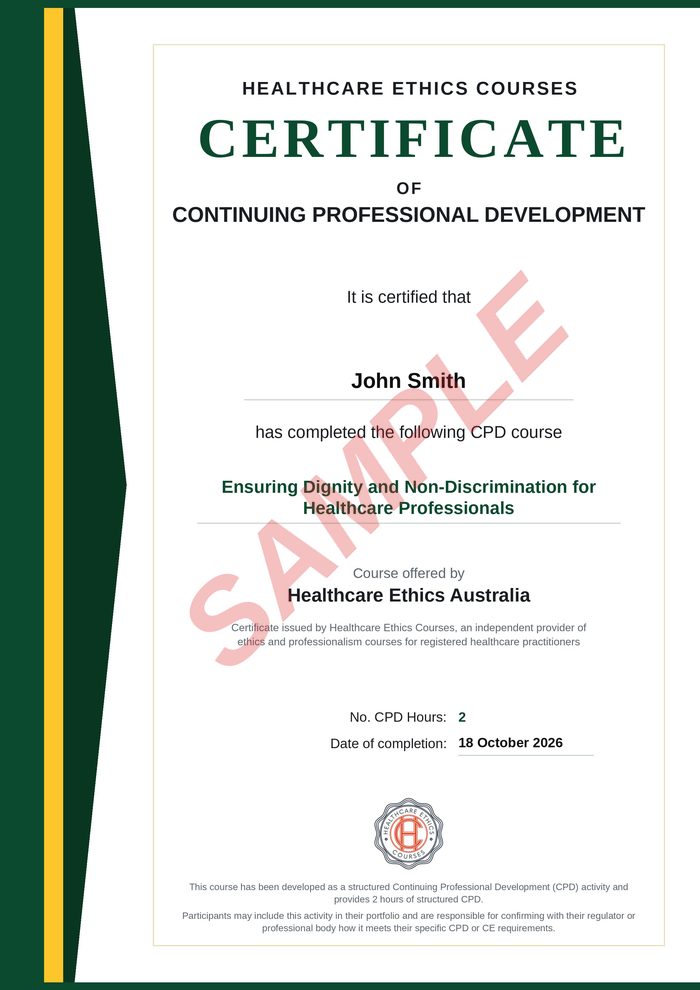
- Certificate issued by Healthcare Ethics Courses on completion, dated, with the course title and 2 CPD hours
- Written by
- Dr Shehzad Iqbal, MBBS, MRCS, MRCGP, Postgraduate Certificate in Healthcare Law and Ethics, who also reviews it
- Price
- A$200 · from A$140 a course (Bulk Buy of 10)
Certificate issued by Healthcare Ethics CoursesAhpra remediation courses for regulatory processes.
The certificate you will receive
How practitioners use it
- For an Ahpra notification or Board investigation, with a reflection piece
- In a portfolio for a panel or tribunal hearing
- As evidence of remediation, or of CPD on dignity, bias and cultural safety, in a CPD record
Who this course is for
Facing an allegation of discrimination or racism
A patient, a family member or a colleague says they were treated less favourably because of their race, religion, sex, gender identity, sexual orientation, disability or age. Clause 1.3 of the shared Code of conduct asks you to “not engage in any form of discrimination”, and in February 2025 Ahpra and the National Boards said together that discrimination and racism will not be tolerated. This course is how you show the episode examined, and the change.
Dealing with an Ahpra notification or complaint
A patient, a colleague, your employer or a mandatory notifier has told Ahpra, and you have been asked for a written response. In 2024/25 Ahpra received 13,327 notifications across the 16 registered professions, and the share whose primary concern was a practitioner’s behaviour rose to 6.9%, from 4.8% the year before. Your response is the first place you set out your own part; this course helps you set it out: your part, the episode examined, the effect and the change.
A complaint about a remark, your manner or a lack of dignity in care
A comment at the bedside, a tone that changed with the patient in front of you, an examination with the door open, a patient discussed in a corridor, or a note in the record that described the person rather than the problem. The Australian Charter of Healthcare Rights says a patient can expect to “be treated as an individual, and with dignity and respect”, and clause 8.3 of the shared Code asks for records that do not include demeaning or derogatory remarks.
Under investigation, or under immediate action
Ahpra is investigating, or the Board has suspended your registration or imposed conditions while it does. An investigator reads the record, any messages or posts, and the accounts of the patient and of colleagues beside yours — and reads for insight in your account, with dated, targeted remediation alongside it.
Facing a panel or a tribunal hearing
A performance and professional standards panel has been convened, or the Board has referred you to the tribunal in your state or territory. A panel asks whether you can describe what the patient or colleague experienced; a tribunal weighs insight, remediation and conduct since the events. Remediation completed before the hearing, dated and documented, is part of what both of them weigh.
Advised to take a course, or taking it as CPD
Your supervisor, employer or adviser has suggested remediation on discrimination, cultural safety or respectful practice, and you want dated work you can show. Or nothing has been raised and you want CPD hours on what your code sets out about dignity, bias and cultural safety. The certificate records two dated CPD hours, the course title and the date.
The concerns this course speaks to
Discrimination, and a different standard of care
Less time, less explanation, a slower referral, pain taken less seriously, an investigation not offered. Clause 1.3 of the shared Code says “your decisions about access to care must be free from bias and discrimination”, and Good medical practice 3.4.3 names race, religion, sex, gender identity, sexual orientation and disability among the grounds. The course works through direct and indirect discrimination, and asks the question that answers this kind of concern: would another patient have been treated the same way?
Impairment — a health matter alongside the concern
A concern about how a patient or a colleague was treated can come with a health matter: fatigue, alcohol, drugs or a health condition that affected a remark or a manner. Clause 9.1 of the shared Code (Your health), and the health sections of the codes for doctors, nurses, midwives and psychologists, ask you to seek help for a condition that could affect your practice. The health matter is one for your treating practitioner and your response; this course deals with the conduct and how you treated the person.
Racism, and cultural safety for Aboriginal and Torres Strait Islander Peoples
A remark, an assumption or a decision about an Aboriginal or Torres Strait Islander patient or colleague. Clause 2.2 of the shared Code asks you to “acknowledge and address individual racism, your own biases, assumptions, stereotypes and prejudices and provide care that is holistic, free of bias and racism”, and since October 2022 the National Law names the elimination of racism in health services among the scheme’s guiding principles. The course gives racism and cultural safety a lesson of its own and a case study.
Assumptions about weight, mental health, drug use or circumstances
Symptoms put down to anxiety, weight or alcohol before they were assessed; a patient who missed appointments treated as unlikely to follow a plan; someone without stable housing given less explanation. Clause 1.3(b) asks you to “not prejudice the care of a patient because you believe that the behaviour, mental health status or other attributes of the patient have contributed to their condition”. The course covers implicit bias and the assumptions that lower the standard of care, diagnostic overshadowing among them.
Dignity and privacy during examination and care
Exposure that was not needed, an examination without a screen or a closed door, people present who did not need to be, a patient spoken about in front of others. The Charter of Healthcare Rights includes having “my personal privacy respected”, and clause 4.1 of the shared Code asks you to be “courteous, respectful, compassionate and honest”. The course treats privacy and dignity during examination and care, and how patients are spoken about, as practical behaviours with a lesson each.
Language, interpreters and speaking to the patient
A relative used to interpret a diagnosis, a consent obtained through a family member, a patient spoken about rather than to. Clause 3.2(d) of the shared Code asks you to take all practical steps to meet patients’ language, cultural and communication needs, “including by using translating and interpreting services where necessary”, and Good medical practice 4.3.8 asks doctors to use qualified interpreters. One of the course’s case studies is an interpreter not arranged.
Discrimination, bullying and harassment of a colleague
A remark about a colleague’s religion, pregnancy, accent or background, exclusion from a team, humiliation in front of others, or a message in a group chat. Clause 5.3 of the shared Code opens: “There is no place for discrimination (including racism), bullying and harassment, including sexual harassment, in healthcare in Australia.” In 2023 a tribunal reprimanded a doctor, disqualified him from applying for registration for 12 months and barred him from providing any health service for 12 months, after he forwarded an email with offensive comments to a First Nations colleague. The course covers your conduct and your duty to act on what you see.
Personal beliefs, conscientious objection and access to care
A moral or religious view that delayed a referral, information withheld, or an objection that left the patient without another care option. Clause 1.3(f) asks you to “not allow your moral or religious views or conscientious objection to deny patients access to healthcare”, while recognising that you may decline to take part yourself, informing the patient respectfully and making sure there are other options. The course sets out where the right to object ends and the duty to the patient continues.
Facing an Ahpra notification, complaint or allegation? This Ahpra remediation course helps you address the concern — and demonstrate it.
Buy this course — A$200 (A$140 with Bulk Buy 10)What the course covers
Nine sections and 56 lessons, with a reflective quiz closing each of the first eight and a post-course assessment at the end.
Introduction to dignity and non-discrimination
What dignity and non-discrimination mean in Australian healthcare, why they matter to patients, colleagues and your registration, how a concern reaches Ahpra and the Boards, and the standards the course is built on.
Key concepts of dignity in patient care
Six lessons: person-centred care and partnership, privacy and dignity during examination and care, how patients are spoken about, empathy and compassion as practical behaviours, respecting choices and the dignity of risk, and patients with disability or additional communication needs.
Understanding and preventing discrimination
Ten lessons: direct and indirect discrimination, harassment and vilification; the grounds in law and the wider grounds in your code; implicit bias; the assumptions that lower the standard of care; racism and cultural safety for Aboriginal and Torres Strait Islander Peoples; culture, language, religion and belief; sex, gender identity, sexual orientation and intersex variations; conscientious objection and its limits; reasonable adjustments; and an inclusive environment.
Standards and expectations
Eight lessons: the National Law and the codes as evidence, the shared Code of conduct, Good medical practice, the NMBA codes, the Psychology Board’s code, anti-discrimination law, the Charter of Healthcare Rights and the NSQHS Standards, and what happens when the standards are not met.
Communication, dignity and respect
Six lessons: verbal and non-verbal communication that conveys respect, language that demeans, speaking to the patient rather than around them — relatives, carers and interpreters — de-escalation, difficult news, and respectful communication with colleagues and in the health record.
Addressing breaches
Recognising a breach, discrimination, bullying and harassment of colleagues, your duty to act when you witness it, accountability and apology, and four case studies: a remark at the bedside, a different threshold for investigation, an interpreter not arranged, and comments about a colleague.
Remediation for practitioners facing regulatory concerns
Six lessons: acknowledging the concern without defensiveness, why “I am not prejudiced” answers the wrong question, examining the episode against how another patient would have been treated, a remediation plan, the evidence of change, and professionalism while the process runs.
Personal and professional development
Five lessons: a development plan for respectful practice, reflection that produces evidence, CPD on dignity, bias and cultural safety, supervision, mentoring and peer feedback, and sustaining respectful practice over time.
Conclusion and key takeaways
Key takeaways, then the post-course assessment. Your certificate is issued on completion and carries the date.
Show every lesson title
- Section 01 · Introduction to Dignity and Non-Discrimination
- What Dignity and Non-Discrimination Mean in Australian Healthcare; Why They Matter to Patients, Colleagues and Your Registration; How a Dignity or Discrimination Concern Reaches Ahpra and the Boards; The Standards This Course Is Built On.
- Section 02 · Key Concepts of Dignity in Patient Care
- Person-Centred Care and Partnership With Patients; Privacy and Dignity During Examination and Care; Confidentiality and How Patients Are Spoken About; Empathy and Compassion as Practical Behaviours; Respecting Choices, Autonomy and the Dignity of Risk; Dignity for Patients With Disability or Additional Communication Needs.
- Section 03 · Understanding and Preventing Discrimination
- Direct and Indirect Discrimination, Harassment and Vilification; The Grounds in Law and the Wider Grounds in Your Code; Implicit Bias and How It Shapes Clinical Decisions; Assumptions That Lower the Standard of Care; Racism and Cultural Safety for Aboriginal and Torres Strait Islander Peoples; Cultural Safety for All Communities: Culture, Language, Religion and Belief; Sex, Gender Identity, Sexual Orientation and Intersex Variations; Personal Beliefs, Conscientious Objection and Their Limits; Reasonable Adjustments and Access to Care; Creating an Inclusive Environment for Patients and Colleagues.
- Section 04 · Standards and Expectations
- The National Law: Unprofessional Conduct and the Codes as Evidence; The Shared Code of Conduct: Clauses 1.3, 2, 3.1, 3.2, 5.1 and 5.3; Good Medical Practice for Doctors; The NMBA Codes of Conduct for Nurses and Midwives; The Psychology Board’s Code of Conduct; Anti-Discrimination Law in Australia: Commonwealth, State and Territory; The Australian Charter of Healthcare Rights and the NSQHS Standards; What Happens When the Standards Are Not Met.
- Section 05 · Communication, Dignity and Respect
- Verbal and Non-Verbal Communication That Conveys Respect; Language That Demeans: Labels, Jokes and Remarks; Speaking to the Patient, Not Around Them: Relatives, Carers and Interpreters; De-escalation and Conflict Resolution; Delivering Difficult News With Sensitivity; Respectful Communication With Colleagues and in the Health Record.
- Section 06 · Addressing Breaches
- Recognising a Breach of Dignity or Non-Discrimination Standards; Discrimination, Bullying and Harassment of Colleagues; When You Witness It: Your Duty to Act; Self-Reflection and Accountability After a Breach; Apologising and Responding to a Complaint; Case Study 1: A Remark at the Bedside; Case Study 2: A Different Threshold for Investigation; Case Study 3: An Interpreter Not Arranged; Case Study 4: Comments About a Colleague.
- Section 07 · Remediation for Practitioners Facing Regulatory Concerns
- Acknowledging the Concern Without Defensiveness; “I Am Not Prejudiced”: Why Denial Answers the Wrong Question; Examining the Episode: Would Another Patient Have Been Treated the Same Way?; Building a Remediation Plan; Evidence of Change: Reflection, Supervision, Audit and Feedback; Maintaining Professionalism While the Process Runs.
- Section 08 · Personal and Professional Development
- A Personal Development Plan for Respectful Practice; Reflective Practice That Produces Evidence; Using CPD on Dignity, Bias and Cultural Safety; Supervision, Mentoring and Peer Feedback; Sustaining Respectful Practice Over Time.
- Section 09 · Conclusion and Key Takeaways
- Conclusion; Key Takeaways.
How to respond to an Ahpra notification, complaint or allegation
Set out a response to a dignity or discrimination concern in four parts, in this order: your part, the episode examined, the effect on the person, and what has changed. Ahpra says it needs to understand how you responded to the event — accepting accountability, declaring what happened, actively reflecting and updating your knowledge and skills, and being able to say how you would respond in similar circumstances in future. The course covers each of them.
Saying you are not prejudiced answers a question the panel has not asked.
- Your partWhat you said, did and decided, in the first person — the remark, the examination, the referral not made, the interpreter not booked — neither explaining it away nor describing your character instead.The course’s remediation section: acknowledging the concern without defensiveness.
- The episode, examinedWhat was decided, offered and explained, how long was spent, who was present — and whether any of it would have been different for another patient or another colleague. That question can be answered honestly without accepting that you hold prejudiced views.The course asks the comparator question lesson by lesson, and in four case studies.
- The effect on the personWhat the patient or colleague experienced, in their terms rather than yours, and the clause named from your own Board’s code: 1.3, 2.2, 3.1, 3.2 or 5.3 in the shared Code; 3.4, 4.8 or 5.4 in Good medical practice.The course sets out every code and the Charter of Healthcare Rights.
- The changeAn interpreter booked as routine, a screen and a closed door, a check of your own recent decisions for the same pattern, feedback from patients and colleagues gathered through someone else, supervision with written reports — each dated.This course is the dated item you attach — and it names the other evidence.
The question is not what you believe; it is what happened, and whether it would have happened to someone else.
Take advice from your indemnity insurer or defence organisation, your union or professional association, or a lawyer before you respond to anyone.
Facing an Ahpra notification, complaint or allegation? This Ahpra remediation course helps you address the concern — and demonstrate it.
Buy this course — A$200 (A$140 with Bulk Buy 10)How this course helps if a concern has been raised
The instinct to deny prejudice is the response that fails
You may want to say the same things first: that you are not prejudiced, that you treat everyone the same, that you have cared for people from every background for years. It is sincere, and it does not help, because it answers a question the panel has not asked. The codes assume that bias can affect decisions without your intending it: clause 2.2 of the shared Code asks you to “acknowledge and address” your own biases, assumptions, stereotypes and prejudices, which is a duty that would make no sense if good intent were enough. A declaration of good intent does not answer the concern; an examination of what happened can.
Examine the episode, not your character
What answers a dignity or discrimination concern is the specific episode. What was decided, what was offered, what was explained, how long was spent, who was in the room — and whether any of that would plausibly have been different for a different patient. That is the comparator question, and it can be answered honestly without accepting that you hold prejudiced views, which is why it is a useful way to answer a concern that can otherwise feel impossible to answer. It is also the route that produces evidence: a documented review of the episode, structured feedback, a check of your own recent decisions for the same pattern, and specific changes in how you take a history, offer options, book an interpreter or examine a patient.
Remediation evidence that counts
Counts: a reflective statement that names your own part and cites your Board’s code by clause; CPD targeted to the concern, this course’s dated certificate among it; a review of your own recent decisions for the same pattern, repeated after an interval; supervision or mentoring with written reports; feedback from patients and colleagues gathered on purpose; interpreter use and adjustments recorded in the notes. Counts for little: an apology followed by “but”, a list of the diverse patients or colleagues you have worked with, a character reference in place of an account, CPD hours on another subject, a reflection written by someone else, a promise where evidence should be. For the stages from the first letter to a tribunal, see the Ahpra investigation process, explained.
Read the primary sources
- Shared Code of conduct, clauses 1.3, 2.2, 3.1 and 5.3
- Good medical practice, Medical Board of Australia (doctors)
- NMBA professional standards (nurses and midwives)
- Ahpra and the National Boards: discrimination and racism will not be tolerated (21 February 2025)
- Ahpra: Aboriginal and Torres Strait Islander health and cultural safety
Using this course as CPD
Each National Board sets its own CPD registration standard: for example 20 hours a year for nurses, midwives, physiotherapists, optometrists and chiropractors, 25 hours a year for osteopaths, 20 hours plus 10 hours of peer consultation a year for psychologists, 40 CPD credits a year for pharmacists, 60 hours over three years for dental practitioners and 50 hours a year for doctors. This course is 2 hours of learning on dignity, non-discrimination and cultural safety, written to the National Boards’ codes of conduct, that you can record towards yours.
- 2 CPD hours on a dated certificate showing your name, the course title, the provider and the date you completed it.
- Your own Board’s standard. Record the course against your Board’s CPD requirements and link it to your learning goals for the year.
- Doctors log it with their CPD home; the Medical Board’s CPD requirements include activities on ethical practice and professionalism.
- Chiropractors: the Chiropractic Board’s standard says education, training, mentoring or supervision required by the Board, a Professional Standards Panel or a tribunal cannot be counted as CPD; a course you choose to take can be.
- Your records. Keep the certificate with your CPD records for as long as your Board’s standard asks, in case of an audit.
Read our guide: ethics CPD for healthcare professionals in Australia →
Who wrote it

Dr Shehzad Iqbal
Course author and facilitator, Healthcare Ethics Australia
Dr Iqbal has designed and delivered remediation courses in ethics, probity and professionalism for healthcare professionals since 2020, working with registrants across regulated health professions, online and face to face. He combines clinical practice with formal postgraduate training in healthcare law and ethics.
MBBS · MRCS · MRCGP · Postgraduate Certificate in Healthcare Law and Ethics, University of Dundee
Written and reviewed by Dr Shehzad Iqbal. Last reviewed . Read Dr Iqbal’s profile →
In short
Ensuring Dignity and Non-Discrimination for Healthcare Professionals is a self-paced remediation course of 2 hours for practitioners registered with any of Australia’s fifteen National Boards facing an Ahpra notification, complaint or allegation about how a patient or a colleague was treated: discrimination or racism, an assumption that lowered the standard of care, a lack of dignity or privacy in care, a relative used in place of an interpreter, a belief that delayed or prevented a patient’s care, or discrimination, bullying or harassment of a colleague. It covers the codes, the National Law, anti-discrimination law, cultural safety, implicit bias, communication, four case studies, insight and remediation, and practitioners also take it as CPD. It is not accredited by Ahpra or any National Board, and no course determines the outcome of a notification.
What the codes say about dignity and discrimination
Respect for the people in your care, and for colleagues, is written into every National Board’s code. The shared Code of conduct that twelve Boards use sets the standard in its first section: “Your decisions about access to care must be free from bias and discrimination” (1.3). It gives cultural safety two sections — for Aboriginal and Torres Strait Islander Peoples (2.1 and 2.2) and for all communities (3.1) — asks for interpreters where necessary (3.2), respect for colleagues (5.1), and has a clause of its own on discrimination, bullying and harassment (5.3). Good medical practice says the same for doctors at 3.4, 4.7, 4.8 and 5.4; the NMBA codes and the Psychology Board’s code, in force since 1 December 2025, cover the same ground under their own numbering. In March 2025 the NMBA adopted the National Scheme definition of cultural safety.
Two things are Australian. The first is cultural safety for Aboriginal and Torres Strait Islander Peoples, which since October 2022 sits in the National Law itself: among the scheme’s guiding principles, the development of a culturally safe and respectful health workforce that “contributes to the elimination of racism in the provision of health services”. The second is the route: a concern can reach the Board from a patient, a colleague, an employer or a health complaints body, and in New South Wales and Queensland it is your profession’s Council of NSW and the HCCC, or the Office of the Health Ombudsman, that receive the complaint first. Anti-discrimination law applies separately from the code, but the code is the standard the Board applies, and it reaches conduct the law does not.
Your standards go wider than the law does
The codes did not simply adopt the legal categories, and a written response that answers only the law answers only part of the question.
The attributes protected by law
The Commonwealth Acts protect race, colour, descent, national or ethnic origin and, in some circumstances, immigrant status; sex, marital or relationship status, pregnancy or potential pregnancy, breastfeeding, family responsibilities, sexual orientation, gender identity and intersex status; disability; and age. Each state and territory has its own Act as well, and providing health services is an area all of them cover.
And the codes reach further
Clause 1.3(b) of the shared Code asks you to “not prejudice the care of a patient because you believe that the behaviour, mental health status or other attributes of the patient have contributed to their condition”, and 3.1(d) to “challenge belief based upon assumption” — naming political beliefs alongside gender, disability, race, ethnicity, religion, sexuality and age. Neither depends on the conduct being unlawful.
Which is where concerns arise
Assumptions about a patient who drinks, who uses drugs, who has a mental health history, who has no stable housing, who missed appointments, or who has been described in the notes as difficult. Some of these are not grounds in the Commonwealth Acts, and a mental health history can be one, as a disability under the Disability Discrimination Act; all of them are inside the code. These are the matters this course works through.
Three duties, not one
The first is the duty you will already know. The second and third are where a written response can be incomplete.
01 · Do not discriminate
Clause 1.3(c) of the shared Code asks you to “not engage in any form of discrimination”, and Good medical practice 5.4.2 says “not discriminating against, bullying or sexually harassing others” — towards patients and towards colleagues alike.
02 · Be aware of your own bias, and act on it
Clause 2.2(b) asks you to “acknowledge and address individual racism, your own biases, assumptions, stereotypes and prejudices”, and 3.1(d) to “avoid bias, discrimination and racism”. Awareness alone is not the duty; addressing it is.
03 · Act on what you see in others
Clause 5.3(d) asks you to “do or say something about discrimination, bullying or harassment by others when you see it and report it when appropriate”, and 5.3(f) to escalate if an appropriate response does not occur. Doing nothing is a position the Board can examine.
What these words mean
The four terms that matter most here, and the other words on this page.
- Discrimination
- The shared Code’s definition: “Discrimination occurs when a person, or a group of people, is treated less favourably than another person or group because of their background or certain personal characteristics”. Direct discrimination is less favourable treatment because of the attribute itself; indirect discrimination is a rule or practice applied to everyone that disadvantages people with an attribute and is not reasonable in the circumstances.
- Cultural safety
- The National Scheme definition, which the National Boards and Ahpra use: “Cultural safety is determined by Aboriginal and Torres Strait Islander individuals, families and communities. Culturally safe practise is the ongoing critical reflection of health practitioner knowledge, skills, attitudes, practising behaviours and power differentials in delivering safe, accessible and responsive healthcare free of racism.”
- Notification
- Ahpra’s word for a complaint or a concern about a registered practitioner, from a patient, a colleague, an employer or a mandatory notifier. Every notification is assessed for risk to the public. Where Ahpra can, it tells you about the concern and may ask for a written response, and that response is read at every later stage. In 2024/25 Ahpra received 13,327 notifications across the 16 registered professions (22,658 nationally, including New South Wales and Queensland).
- The four National Law grounds
- The National Law names four grounds on which a Board acts: impairment (a health matter, not a conduct finding), unsatisfactory professional performance (knowledge, skill, judgement or care below the standard of a peer), unprofessional conduct (conduct below what peers and the public reasonably expect) and professional misconduct (substantially below that standard, or conduct inconsistent with being a fit and proper person to hold registration, found only by a tribunal). Which one your letter uses tells you how the matter is being treated.
Dignity, implicit bias, racism, harassment, bullying, sexual harassment, reasonable adjustment, immediate action, insight, remediation and the other terms the course uses
- Dignity
- Treating a person as an individual whose worth does not depend on their condition, their circumstances or how they came to need care. The Charter of Healthcare Rights puts it as the right to “be treated as an individual, and with dignity and respect”; in practice it shows in privacy, who is present, how a person is spoken to and spoken about, and whose choices shape the care.
- Implicit bias
- An attitude or assumption about a group that shapes perception and decisions without your intending it — sometimes called unconscious bias. It is the reason the codes ask you to address your own biases rather than declare that you have none, and the reason the evidence of change is a review of decisions rather than a statement of values.
- Racism
- The shared Code’s definition: “Racism includes prejudice, discrimination or hatred directed at someone because of their colour, ethnicity or national origin.” The code also names systemic racism, which clause 2.2(a) asks practitioners to acknowledge.
- Harassment
- The shared Code’s definition: “to treat a person less favourably on the basis of certain personal characteristics, such as race, sex, pregnancy, marital status, breastfeeding, age, disability, sexual orientation, gender identity or intersex status”.
- Bullying
- The shared Code’s definition: “Bullying is when people repeatedly and intentionally use words or actions against someone or a group of people to cause distress and risk to their wellbeing.” Clause 5.3(b) lists humiliation, exclusion and intimidation among its forms.
- Sexual harassment
- The shared Code’s definition: “unwelcome sexual conduct that a reasonable person would anticipate would offend, humiliate or intimidate the person harassed”. Since December 2022 the Sex Discrimination Act places a positive duty on employers and persons conducting a business or undertaking to take reasonable and proportionate measures to eliminate it.
- Reasonable adjustment
- A change to how care is provided so that a person with disability is not treated less favourably — a longer appointment, an accessible room, information in another format, a support person present. Under section 5(2) of the Disability Discrimination Act 1992, not making a reasonable adjustment can itself be discrimination; an adjustment that would impose unjustifiable hardship is not a reasonable adjustment.
- Immediate action
- The step a National Board may take at any stage under section 156 of the National Law where it reasonably believes a practitioner poses a serious risk to persons and immediate action is needed to protect public health or safety, or that action is otherwise in the public interest: suspending registration, imposing conditions, or accepting an undertaking or the surrender of registration while the matter continues. A protective step, not a finding, and reviewable.
- Insight
- In a dignity or discrimination matter, being able to describe what the patient or colleague experienced, what your part in it was, and how the episode would have gone for someone else — without explaining it away. In a written response, say what your part was before describing anything else.
- Remediation
- Concrete change, evidenced and dated: a review of your own decisions, interpreters and adjustments recorded as routine, feedback gathered on purpose, supervision with written reports, and CPD targeted to the concern.
The clauses a discrimination or dignity allegation engages
Read off the shared Code of conduct, which twelve National Boards use; if you are a doctor, a nurse, a midwife or a psychologist, your own code covers the same ground under different numbers — for doctors, Good medical practice 3.4, 4.7, 4.8 and 5.4. A concern about how a patient was treated engages 1.3 first, and cultural safety and communication beside it; a concern about a colleague engages 5.3. The rest are below.
1.3 — Decisions about access to care
The central clause for a patient’s concern. “Your decisions about access to care must be free from bias and discrimination.” It asks you to treat patients with respect at all times, not to prejudice care because of a patient’s behaviour, mental health status or other attributes, not to engage in any form of discrimination, and to investigate and treat on clinical need. Point (f) sets the limit of conscientious objection: free to decline yourself, never to deny the patient access to care.
For this course: the comparator question — would another patient have been treated the same way? — is the course’s method for examining the decision this clause asks about.
2.2 — Cultural safety for Aboriginal and Torres Strait Islander Peoples
To ensure culturally safe and respectful practice you must acknowledge colonisation and systemic racism, acknowledge and address individual racism and your own biases, assumptions, stereotypes and prejudices, recognise self-determined decision-making driven by the individual, family and community, and foster a safe working environment that supports the rights and dignity of Aboriginal and Torres Strait Islander people and colleagues.
For this course: racism and cultural safety for Aboriginal and Torres Strait Islander Peoples have a lesson of their own and a case study, built on the National Scheme definition.
3.1 — Cultural safety for all communities
“Only the patient and/or their family can determine whether or not care is culturally safe and respectful.” The clause asks you to respect diverse cultures, beliefs, gender identities, sexualities and experiences, including among your team, and to adopt practices that respect diversity, avoid bias, discrimination and racism, and challenge belief based upon assumption.
For this course: culture, language, religion and belief, and sex, gender identity, sexual orientation and intersex variations, are lessons of their own.
5.3 — Discrimination, bullying and harassment
Never engage in, ignore or excuse discrimination, bullying and harassment; recognise its forms, including racism, humiliation, exclusion and intimidation; do or say something about it when you see it, and report it when appropriate; escalate if an appropriate response does not occur; refer concerns to the Board or Ahpra where there is ongoing or serious risk; and support colleagues who report it.
For this course: conduct towards colleagues and the duty to act when you witness it are the course’s breaches lessons, with a case study about comments made about a colleague.
Also engaged: 3.2 — effective communication: point (d), interpreting services where necessary and awareness of how language needs affect understanding · 4.1 — partnership: “be courteous, respectful, compassionate and honest” · 4.4 — relatives, carers and partners: considerate of their role, with consent before information is shared · 5.1 — respect for colleagues: professional and courteous at all times, including on social media · 8.3 — health records: point (c), records that respect the patient and contain no demeaning or derogatory remarks · 4.6 — complaints: acknowledge the patient’s right to raise concerns, work to resolve them, make sure the complaint or notification does not affect the patient’s care, and work with the regulator on a prompt, open and constructive response.
What happens after a discrimination or dignity notification reaches Ahpra
The same stages as any notification, set by the National Law, whichever Board registers you — and at every one the reader asks the same things: what happened, would it have happened to someone else, what was your part, and what has changed?
Assessment: what happened, and would it have happened to someone else?
Ahpra and the Board assess every notification for risk to the public and, where they can, tell you about it and may ask for your written response. A response that examines the episode, names the clause from your own code and attaches dated remediation can end a matter here, with no further action or advice.
Immediate action, where the risk is current
At any stage, where the Board reasonably believes a practitioner poses a serious risk and immediate action is needed to protect the public, or that action is otherwise in the public interest, it may suspend registration, impose conditions, or accept an undertaking or the surrender of registration while the matter continues (section 156). A protective step, not a finding, and reviewable — and the response to it is read like any other. On a dignity or discrimination matter the conditions can include supervision, mentoring or a chaperone.
Investigation: is your account consistent with the record and the other accounts?
Where more is needed, Ahpra investigates (section 160): some information is gathered through a case discussion at which you may be represented, some under compulsory powers. The investigator reads the clinical record, any messages or posts, whether an interpreter was booked, and the accounts of the patient and of colleagues beside yours; a demeaning remark in the record engages clause 8.3 of the shared Code on its own.
Health or performance assessment: did a health or performance issue contribute?
Where the concern is about health or about performance rather than conduct, the Board may require a health assessment or a performance assessment (sections 169 and 170) as well as, or instead of, an investigation. Impairment is a health matter under the National Law, dealt with under its own route with support, and a condition declared early, with a plan, can show insight. Fatigue, burnout or a condition behind a remark or a manner can make a conduct matter a health matter as well.
A panel: can the practitioner see the effect on the person, and their own part?
The Board may refer a matter to a health panel or a performance and professional standards panel (sections 181 and 182). If it makes a finding, a panel can impose conditions; a performance and professional standards panel can also caution or reprimand you, and a health panel can suspend registration. A panel can also refer the matter to a tribunal. It cannot cancel registration. On a dignity or discrimination matter it asks whether you can describe what the patient or colleague experienced, and what you would do differently.
The tribunal: what should follow?
The most serious matters go to the tribunal in your state or territory (section 193), which can reprimand, impose conditions, fine up to A$30,000, suspend, cancel registration and disqualify (section 196). In 2024/25, 94.3% of tribunal matters resulted in disciplinary action (Ahpra annual report). In 2023 the ACT Civil and Administrative Tribunal found professional misconduct where a doctor forwarded to a First Nations colleague he had never met an email with offensive comments about a medicines policy for Aboriginal and Torres Strait Islander people, reprimanded him and disqualified him from applying for registration for 12 months (Medical Board of Australia v CDA [2023] ACAT 64).
Who investigates in New South Wales and Queensland
Two states have their own arrangements, and they apply to all sixteen professions alike. New South Wales conduct matters do not go to Ahpra: your profession’s Council of NSW manages standards and conditions and the Health Care Complaints Commission (HCCC) investigates and prosecutes. In Queensland every complaint goes first to the Office of the Health Ombudsman (OHO), which decides which complaints it keeps and refers the rest to Ahpra and your Board. Ahpra sets both out at reporting concerns in New South Wales or Queensland. A complaint about discrimination can also go to the anti-discrimination body in your state or territory or to the Australian Human Rights Commission; that is a separate process from the one about your registration, and the letter tells you which body is dealing with which complaint.
Facing an Ahpra notification, complaint or allegation? This Ahpra remediation course helps you address the concern — and demonstrate it.
Buy this course — A$200 (A$140 with Bulk Buy 10)Whatever your profession: Ahpra and the National Boards regulate 16 professions under the National Law, and the process is the same for all — courses for every registered profession →
Frequently asked questions
Can I use this course for my CPD and in my response to an Ahpra complaint or investigation?
Yes, for both.
For CPD: Every National Board asks for CPD relevant to your practice, and you choose it. For example: 20 hours a year for nurses, midwives, physiotherapists, optometrists and chiropractors; 25 hours a year for osteopaths; 20 hours plus 10 hours of peer consultation a year for psychologists; 40 CPD credits a year for pharmacists; 60 hours over three years for dental practitioners; and 50 hours a year for doctors. This course gives 2 hours and a dated certificate to record towards your Board’s standard.
For a complaint, notification or investigation: Ahpra says “We consider any steps taken by you or your workplace to strengthen your practice.” Its own website gives an example: a practitioner “undertook self-directed learning in relation to clinical record keeping”. The Board then took no further action, because the practitioner had already taken appropriate steps to fix the concern. A course on the concern, together with your written reflection, can be that kind of step. You choose it, and your Board weighs it with everything else. In New South Wales, the Health Professional Councils say they review your reflection on what happened, and “any steps you’ve taken since the incident to prevent similar issues.”
Sources: Ahpra, What to expect; Ahpra, Possible outcomes; Health Professional Councils Authority (NSW), A complaint has been made about me.
What does my Board want in a response to a discrimination or dignity concern?
Your own part, first, and then the episode examined. What you said and did, what you decided and offered, how long you spent and who was present — read against the record and the other accounts; whether any of it would have been different for another patient or colleague; the effect on the person, in their terms; the clause named from your own Board’s code (1.3, 2.2, 3.1 or 5.3 in the shared Code); and what has changed, with dates. A statement that you are not prejudiced, or a list of the people you have cared for, does not answer the concern.
Should I take advice before I respond to Ahpra?
Yes — before anything is written to Ahpra, the Board, a panel, a tribunal, your employer or a health complaints body. Your indemnity insurer or defence organisation, your union or professional association, or a lawyer should read a response before it goes, and before you contact anyone involved in the complaint about it. Since 1 December 2025 retaliating against a person who makes a notification has been an offence under the National Law (in South Australia, once the regulation is proclaimed). Nothing on this page is legal advice, and no course determines the outcome of a notification.
What can my Board do about a discrimination or dignity concern?
After an assessment or an investigation the Board may take no further action, caution you, accept an undertaking or impose conditions on your registration (section 178), refer you to a panel (which can impose conditions, caution or reprimand you), or refer the most serious matters to a tribunal (section 193), which can reprimand, impose conditions, fine, suspend, cancel registration and disqualify (section 196). Clause 5.3 of the shared Code names imposing conditions or accepting an undertaking as the kind of regulatory action open to the Board where discrimination, bullying and harassment affect public safety.
Who handles a discrimination notification in New South Wales or Queensland?
In New South Wales, not Ahpra: your profession’s Council of NSW and the Health Care Complaints Commission manage conduct, health and performance matters between them, and Ahpra does not investigate registered practitioners there. In Queensland every complaint goes first to the Office of the Health Ombudsman, which decides what it keeps and what it refers on to Ahpra and the Board. A complaint to an anti-discrimination body or the Australian Human Rights Commission is a separate process from the one about your registration.
What counts as discrimination under my code of conduct?
More than the law alone. The shared Code defines discrimination as a person or group being “treated less favourably than another person or group because of their background or certain personal characteristics”. Direct discrimination is less favourable treatment because of the attribute; indirect discrimination is a rule or practice applied to everyone that disadvantages people with an attribute and is not reasonable. The code then goes wider than the Acts: clause 1.3(b) covers prejudicing care because of a patient’s behaviour or mental health status, and 3.1(d) names political beliefs among the assumptions to challenge.
I am not prejudiced. How can I be facing a discrimination concern?
Because the question is not what you believe; it is what happened and the effect it had. The codes assume that bias can shape decisions without your intending it — clause 2.2 of the shared Code asks you to acknowledge and address your own biases, assumptions, stereotypes and prejudices. A response built on denying prejudice answers a question nobody asked. What a panel needs is the episode examined, the comparison with how another patient would have been treated, and evidence that something has changed.
Do I have to act if I see a colleague discriminating, bullying or harassing someone?
Yes. Clause 5.3(d) of the shared Code asks you to “do or say something about discrimination, bullying or harassment by others when you see it and report it when appropriate”, 5.3(f) to escalate if an appropriate response does not occur, and 5.3(g) to refer concerns to the Board or Ahpra where there is ongoing or serious risk, in addition to mandatory reporting. Good medical practice 5.4.5 says the same for doctors. Doing nothing is a position the Board can examine.
What is cultural safety, and who decides whether care was culturally safe?
The National Scheme definition begins: “Cultural safety is determined by Aboriginal and Torres Strait Islander individuals, families and communities.” Culturally safe practice is described as the ongoing critical reflection of a practitioner’s knowledge, skills, attitudes, practising behaviours and power differentials in delivering safe, accessible and responsive healthcare free of racism. Clause 3.1(a) of the shared Code applies the same idea to all communities: only the patient and/or their family can determine whether care was culturally safe and respectful — which is why a response that argues the point with the patient does not help.
Is unconscious bias a conduct matter?
The bias itself is not what the Board examines; the decisions it shaped are. Clause 2.2(b) of the shared Code asks you to acknowledge and address your own biases, and 1.3 asks for decisions about access to care that are free from bias and discrimination. Where a pattern shows — symptoms put down to anxiety or weight, a slower referral, less explanation — the remediation is a review of your own decisions for that pattern, changes in how you assess and offer options, and the same review repeated after an interval.
The complaint is about my tone or a remark. Is that really a regulatory matter?
It can be, particularly where the person felt they were treated differently from others. Clause 1.3(a) asks you to treat patients with respect at all times, 4.1(a) to be courteous, respectful, compassionate and honest, and 5.1 to behave professionally and courteously towards colleagues, including on social media. The Board is not judging personality; it is asking whether someone received less respect, less explanation or worse care than another person would have. Showing that you understand how it was experienced, and what you have changed, is what helps.
Can I decline to provide care because of my religious or moral beliefs?
You can decline to take part yourself; you cannot let the objection deny the patient care. Clause 1.3(f) of the shared Code asks you to “not allow your moral or religious views or conscientious objection to deny patients access to healthcare”, to inform the patient respectfully, where relevant, along with your employer and colleagues, and to make sure the patient has other care options. Good medical practice 3.4.6 and 3.4.7 say the same for doctors. Some states also require referral by law for particular services.
How do I show a change in something like bias?
With specific, dated evidence. A documented review of the episode; a check of your own recent decisions for the same pattern, repeated after an interval; structured feedback from colleagues and, where appropriate, from patients; changes to how you take a history, offer options, book interpreters and examine; supervision or mentoring with written reports; and a development plan that names behaviours rather than intentions. Sections 7 and 8 of the course are built around producing that evidence.
How long does it take, and how long do I have access?
The course is 2 CPD hours, self-paced, with twelve months’ access from purchase. The certificate is issued on completion, dated, with the course title and the CPD hours, for a response, a portfolio or your CPD record.
Courses that work alongside this one
A notification can raise more than one issue. These are the courses that pair with this one.
Effective Communication for Healthcare Professionals
How a remark, a tone or a difficult conversation is heard, and the communication a respectful consultation is built on.
Ensuring Teamwork and Collaboration
Conduct within a team: respect for colleagues, conflict, psychological safety and speaking up.
Privacy, Consent and Chaperone in Healthcare Practice
Privacy and consent during an examination, and when a chaperone is offered.
Dealing with a Complaint or Investigation Professionally
How to answer a complaint by examining your part rather than defending your character.
Insight for Fitness to Practise
Describing what the patient or colleague experienced is the form of insight a discrimination concern asks for.
Reflection for Fitness to Practise
A reflective statement with a structure: the episode, your part, the effect, and what has changed.
Remediation for Fitness to Practise
A dated remediation plan, with audit and feedback that show the change over time.
Rebuilding Trust of Patients, Colleagues, Public and Healthcare Regulator
Rebuilding trust with the patient, the team and the Board once the concern has been answered.
Ensuring Dignity and Non-Discrimination for Healthcare Professionals
This course. Discrimination and racism, dignity and privacy in care, implicit bias, cultural safety, interpreters, conduct towards colleagues, four case studies, insight and remediation.
See all CPD courses for healthcare professionals in Australia →
Start today, finish at your own pace
Immediate access on purchase. Twelve months' access, a dated certificate on completion, and 2 CPD hours issued by Healthcare Ethics Courses.