Face-to-face course via Zoom · All 15 National Boards
Face-to-Face Ahpra Professional Boundaries Course
Professional Boundaries Course — live via Zoom for practitioners facing an Ahpra notification, complaint or investigation about a boundary with a patient or a colleague, and for CPD
Which of these is your situation?
- Boundaries — an allegation or Ahpra investigation about a boundary with a patient or a colleague
- Relationship — a relationship or contact with a patient, a former patient or a patient’s family
- Consent and chaperones — an examination not explained, or no chaperone offered
- Messages — a text, a friend request or a message from a personal account
- Gifts and money — a gift, a loan or a business dealing with a patient
- Dual relationships — a friend, a relative or a colleague treated, and not managed
- Inappropriate conduct — facing an allegation of a boundary breach or inappropriate conduct?
- CPD — looking for a live CPD course on professional boundaries?
Facing an allegation of a boundary breach — from your National Board, Ahpra, your employer, a panel or a tribunal?
A live course, with a facilitator. Five CPD hours by video link on Zoom, with discussion and structured work on your own case, and a dated certificate for your written response, your portfolio or a Board, panel or tribunal direction.
- 5 CPD hours
- Live via Zoom
- One-to-one available
- Every registered profession
- A$850 with 10 or more online courses
 Dr Shehzad IqbalFounder, course author and facilitatorMBBS, MRCS, MRCGP
 Dr Mo MirzaCourse facilitatorMedically trained, UCL London
 Ludmila UpenieceBusiness development and supportPsychology, UEL London
In short: The Professional Boundaries Course is a live, facilitated face-to-face professional boundaries CPD course run by video link on Zoom, for health practitioners whose Ahpra notification, complaint or investigation concerns a boundary with a patient or a colleague — a relationship or contact outside the clinical setting, consent and chaperones, messages and social media, gifts, or dual relationships — and for CPD. It works through what the codes of conduct say about professional boundaries, the factors behind a breach, and how to show insight and remediation, with an exercise to build your own action plan. 5 CPD hours, A$1,000 (A$850 with 10 or more online courses), one-to-one for A$500 extra, with a dated certificate issued by Healthcare Ethics Australia on completion.
At a glance
- Course name
- Professional Boundaries Course — the name on your certificate
- Who it is for
- Any registered practitioner facing an Ahpra notification, complaint or investigation, a National Board condition, a panel or a tribunal hearing about professional boundaries, and anyone who wants the material for CPD
- Format
- Live and interactive, by video link on Zoom, with a facilitator and other participants; breaks across the course
- CPD
- 5 hours of CPD for your CPD record
- Certificate
- Certificate issued by Healthcare Ethics Australia, part of Healthcare Ethics Courses, dated, with the course title and 5 CPD hours
- Facilitators
- Dr Shehzad Iqbal and Dr Mo Mirza
- Price
- A$1,000 · A$850 with 10 or more online courses · one-to-one A$500 extra
- Dates
- See the next date and book
Certificate issued by Healthcare Ethics Australia, part of Healthcare Ethics CoursesAhpra remediation courses for regulatory processes.
The certificate you will receive
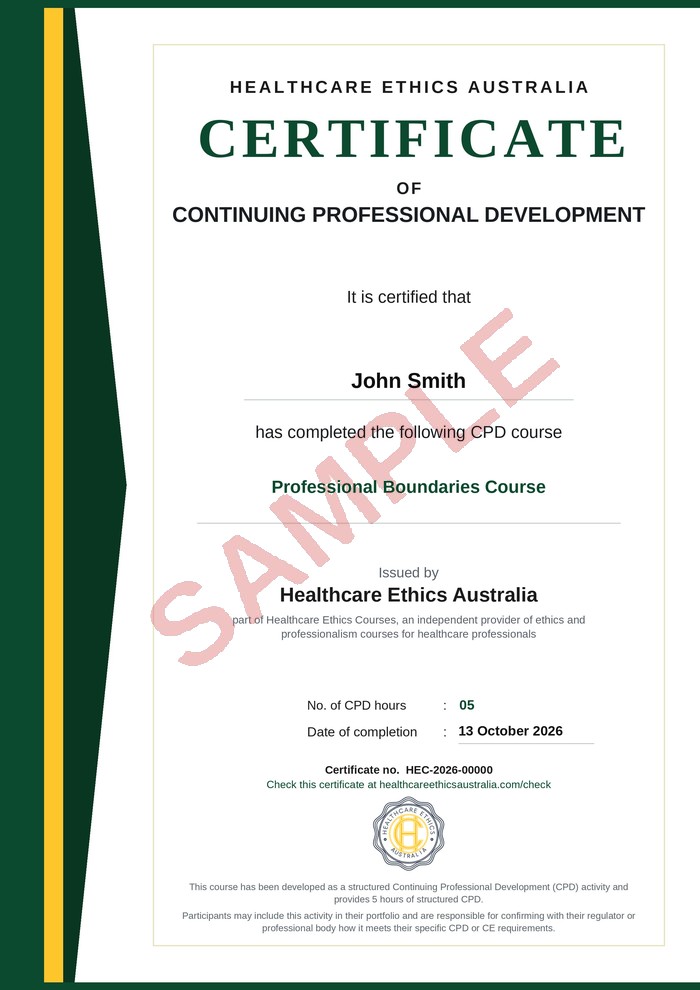
How practitioners use it
- For an Ahpra notification or Board investigation, with a reflection piece
- In a portfolio for a panel or tribunal hearing
- As evidence of education under a condition or undertaking
- As CPD in your CPD record for the year
Who this course is for
Facing an allegation of a boundary breach
Ahpra’s letter describes a relationship or contact with a patient, a former patient or someone close to a patient, or conduct a colleague describes as inappropriate. The responsibility for the boundary sits with the practitioner, whoever moved toward it.
A complaint about consent, a chaperone or an examination
An examination that was not explained, undressing without draping, or a chaperone not offered and the answer not recorded.
A notification about messages, social media or gifts
A text after hours, a friend request accepted, a gift or a loan from a patient. Digital contact leaves a permanent record, and the investigator reads it before your account.
A bullying or harassment complaint from colleagues
A boundary with a colleague, a student or someone you supervise is held to the same standard as one with a patient, and the course treats the two together.
Under an education condition or undertaking
Your Board has imposed a condition, such as a chaperone or supervision, or accepted an undertaking that requires education in professional boundaries.
Building your CPD
You want a facilitated professional boundaries course in your CPD record for the year.
The concerns this course speaks to
Gradual boundary drift
Not a single decision but a sequence: the first exception, the reason for it, the second. The course works through how and why it happens, which is the insight a Board reads for.
Contact outside the clinical setting
Seeing a patient socially, a home visit that was not clinical, or a relationship with a former patient or someone close to a patient.
Consent and chaperones
Explaining an examination before it starts, offering a chaperone, and recording both the offer and the answer.
Messages and social media
Personal channels, friend requests and messages after hours, and how online contact wears away professional distance.
Gifts, loans and business dealings
A gift beyond a token, a loan, a bequest or a business arrangement with a patient, and the conflict of interest that comes with it.
Dual relationships and colleagues
Treating a friend, a relative or a colleague in a small community, managed and recorded; and boundaries with colleagues, students and juniors.
Facing an Ahpra notification, complaint or allegation? A live course, with a facilitator, helps you address the concern — and show the remediation.
See dates and book — A$1,000What the course covers
A live course of 5 CPD hours by Zoom, with breaks, finishing with your own action plan. The certificate is issued on completion.
What professional boundaries are
Emotional, physical and sexual boundaries, and the power imbalance in a professional relationship.
What the codes of conduct say
What the codes of conduct say about professional boundaries, read against your own Board’s code and guidelines.
Why breaches happen
The factors that contribute to boundary violations, and situations where boundaries become blurred, with the risk that follows.
Consent and chaperones
Guidance on consent and chaperones, and the records that show both.
Why boundaries matter
Why professional boundaries matter for health practitioners, for patients and for colleagues.
Keeping boundaries in place
The measures and mechanisms that help maintain professional boundaries in practice.
When a breach happens
What to do when a breach of professional boundaries happens — insight, reflect, remediate.
A personalised action plan
An exercise to formulate a personalised action plan that you leave with.
Dates, price and booking
A$1,000 for the course on its own, or A$850 with 10 or more online courses in your basket — the lower price is applied in the basket. One-to-one for A$500 extra, with the date arranged around you.
Date
Sunday 6th December 2026Live via ZoomThe date does not suit you, or your deadline is close? Ask about an earlier date, or book a free 15-minute Zoom call with Dr Shehzad Iqbal to talk through which course fits. Ten online courses and a live course together: the Bulk Buy Offer.
How this course helps with an Ahpra notification
Boundaries notifications are assessed on the risk of repetition and on insight. A Board reading your response asks whether you recognise where the line was, why it was crossed, and what safeguards now stop it happening again. This course works through the boundaries and consent clauses of the codes and turns them into a structure for your written response, including safeguards such as chaperone arrangements and records that a Board can check.
Read more: Face-to-Face Ahpra Boundaries Course: How a Live Day Helps With a Boundaries Notification
The dated certificate is evidence of education in professional boundaries completed while your matter was open. The courses are aligned with Ahpra and National Board guidelines and standards; confirm with your Board how the 5 CPD hours should be recorded, and take advice from your insurer, union or lawyer before responding.
Read our guide: the Ahpra investigation process, explained →
How the live session works
A facilitated session by video link on Zoom, with breaks across the course. It starts with the regulatory context — what Ahpra and the National Boards say about the concern the course addresses — then works through the standards, case examples, the mistakes practitioners make when responding, and structured work on your own case. Questions are welcome at any point. The course finishes with your action plan, and the certificate is issued and dated on completion. Joining details are sent when you book.
Why live rather than online? The online courses are self-paced and can be started straight away. A live course adds a facilitator who works through your type of concern in real time, discussion with other practitioners in a similar position — which attendees tell us can make a notification feel less isolating — and structured reflection on your own case, so you leave with material you can adapt for your response.
Who facilitates
Dr Shehzad Iqbal
Founder, course author and facilitator, Healthcare Ethics Australia
A practising GP who has designed and delivered ethics, probity and professionalism remediation courses for healthcare professionals since 2020, online and live. He combines clinical practice with formal postgraduate training in healthcare law and ethics, and writes and reviews every course on this site.
MBBS · MRCS · MRCGP · Postgraduate Certificate in Healthcare Law and Ethics, University of Dundee
Written and reviewed by Dr Shehzad Iqbal. Last reviewed . Read Dr Iqbal’s profile →
Dr Mo Mirza
Course facilitator
A medically trained doctor from University College London, educator and UCL postgraduate researcher, with over 25 years’ experience in healthcare, teaching, facilitation and student support. He facilitates reflective learning on probity and ethics, professional boundaries and professional behaviour, using realistic scenarios, guided discussion and structured reflection.
Medical training, University College London · UCL postgraduate researcher · Counselling studies · Small-group facilitation
The clauses this course works through
Clause numbers are from the shared Code of conduct (June 2022), which twelve National Boards use. If you are a doctor, a nurse, a midwife or a psychologist, your own code covers the same ground under different numbers — Good medical practice, the NMBA codes or the Psychology Board’s code — and the course works with whichever code is yours.
4.9 — Professional boundaries
Recognise the inherent power imbalance and maintain boundaries; avoid conflicts of interest and under- or over-involvement; never use your position to pursue an inappropriate relationship with anyone under your care.
4.2 — Informed consent
Information the patient can understand before consent is asked for, time for questions, and the material risks. For an examination, the explanation, the offer of a chaperone and the record of both.
5.1 — Respect for colleagues and other practitioners
Harassment, bullying, favouritism and a relationship at work sit here, and a boundary with a student or someone you supervise is held to the same standard as one with a patient.
8.10 — Conflicts of interest
Gifts, loans, bequests and business dealings with patients declared, and no inducement accepted that may affect your care.
Also engaged: 3.3 — confidentiality and privacy: a message sent through a social channel is not a private one · 8.3 — health records: the examination, the chaperone and the contact recorded at the time.
What happens after a boundaries notification reaches Ahpra
Outside New South Wales and Queensland, Ahpra receives the notification and the relevant National Board decides what happens next: no further action at assessment, an investigation, a health or performance assessment, or referral to a panel or a tribunal. In New South Wales your profession’s Council handles the matter with the Health Care Complaints Commission (HCCC); in Queensland the Office of the Health Ombudsman (OHO) receives complaints and refers some matters to Ahpra. A boundaries concern may close at assessment, go to investigation, or in the most serious cases go to a panel or a tribunal. The standards this course works through apply on every pathway.
Ahpra says it considers any steps taken by you or your workplace to strengthen your practice. A course on the concern, completed and dated while the matter is open, with your own written reflection, can be one of those steps. Take advice from your indemnity insurer or defence organisation, your union or professional association, or a lawyer before you respond to anyone.
The standards a concern is measured against are published by Ahpra and the National Boards. See all Ahpra courses by profession.
Key Takeaways
- Is there a live professional boundaries course for an Ahpra notification? Yes — a face-to-face professional boundaries course delivered live by Zoom with a facilitator, for a notification, complaint or conditions.
- Is a live course good evidence of remediation? Yes — it shows engagement with the concern, and the discussion helps you write your reflective statement.
- When should I book it? Before your written response to Ahpra where you can; it also helps before a panel, tribunal or a review of conditions.
- Does the live course count as CPD? Yes — it is a CPD course, with a certificate issued by Healthcare Ethics Australia, part of Healthcare Ethics Courses.
Frequently asked questions
The relationship never became physical or romantic. Is it still a boundaries matter?
It can be. Boundary concerns include contact outside the clinical setting, gifts, messages on personal channels and gradual over-familiarity, not only the most serious cases. Boards assess the pattern and the risk, and this course covers the full range.
What is the difference between this course and the online Professional Boundaries Course?
The online course is self-paced, 2 CPD hours, and you can start it straight away. This course is live and facilitated by Zoom, 5 CPD hours, with discussion and an exercise on your own action plan. Practitioners can take both.
Are these courses actually face-to-face?
They are live and facilitated in real time by video link on Zoom, with a facilitator and other participants — not recorded and not self-paced. That is what face-to-face means here: you see and speak to the people in the session, and the session is a video call.
Can I count the 5 hours towards CPD?
Yes. The course carries 5 CPD hours, with a dated certificate issued by Healthcare Ethics Australia on completion. Every National Board asks for CPD relevant to your practice and leaves the choice to you; confirm with your Board or your CPD home how the hours should be recorded.
Can it be run one-to-one, or sooner?
Yes. Any of the four live courses can be run one-to-one for A$500 extra, with the date arranged around you. If the published date is too late for your deadline, contact us and we will try to arrange an earlier one.
What does it cost?
A$1,000 for the course on its own. With 10 or more online courses in your basket it comes down to A$850: A$1,400 for ten online courses plus A$850 for the live course, A$2,250 in total. One-to-one is A$500 extra either way.
I practise in New South Wales or Queensland. Is it still relevant?
Yes. The codes and standards are national. In New South Wales your matter is handled by your profession’s Council with the HCCC, and in Queensland complaints go first to the Office of the Health Ombudsman; the course covers both pathways.
Courses that work alongside this one
A notification can raise more than one issue. The other three live courses, and the online courses that pair with this one. Practitioners can pair a live course with online courses on ethics, professionalism, insight, reflection, remediation and fitness to practise, each carrying 2 CPD hours. For every online course on one page, see all Ahpra courses.
Face-to-Face Ahpra Probity and Ethics Course
A notification about dishonesty, records, billing or a conflict of interest.
Face-to-Face Ahpra Ethics and Professionalism Course
A notification about conduct, attitude, manner or professionalism.
Face-to-Face Ahpra Reflection Workshop
Insight, reflection and remediation for your written response.
Ahpra Professional Boundaries Course
The self-paced version of this material.
Ahpra Consent and Chaperone Course
Consent and chaperones in depth.
Ahpra Ethical Boundaries Course
Managing boundaries in practice, with a patient or a colleague.
Ahpra Social Media Course
Online contact and messages.
Professional Boundaries Course
This course: live via Zoom, professional boundaries.
Book a date, or ask about one-to-one
A live course with a facilitator, 5 CPD hours, and a dated certificate issued by Healthcare Ethics Australia. If the listed date does not work, we will try to arrange an earlier one.